Subscribe – Receive new essays as they are published
I. The Stability Illusion
Civilizations construct their moral systems upon an expectation that rarely appears as an assumption: the belief that the surrounding world will remain sufficiently stable for moral rules to retain coherence. Ethical doctrines are written as though institutions will endure, authority will remain recognizable, and the consequences of action will unfold within predictable patterns. Duties, rights, and prohibitions are articulated as if the environment that gives them meaning were permanent.
Within such conditions morality appears timeless. Individuals behave according to stable principles because the surrounding system rewards consistency. Trust persists because institutions punish betrayal with enough reliability to discourage it. Cooperation becomes rational because the benefits of coordination can be anticipated across time. Moral character becomes associated with reliability, and reliability becomes possible because the social world itself behaves in relatively reliable ways.
Equilibrium produces this illusion of permanence.
When societies remain stable long enough, morality begins to feel like an immutable law of nature rather than a structure sustained by institutions. Ethical frameworks developed under such conditions are treated not as historical constructions but as universal truths describing and defining human behavior itself. The rules appear intrinsic rather than contingent. The moral order begins to resemble gravity: something assumed to operate everywhere because it operates here and now.
Yet this permanence is an artifact of equilibrium rather than a property of ethics itself.
Moral systems function only so long as the environments that sustain them remain intact. Their coherence depends upon institutions capable of enforcing consequences, authority structures capable of maintaining legitimacy, and social conditions that make cooperation rational rather than suicidal.
When those conditions begin to fracture, the illusion begins to dissolve.
And environments do not remain stable forever.
II. Morality as an Environmental Structure
Ethical systems do not emerge in abstraction. They arise from particular historical conditions and function as tools for stabilizing those conditions. Moral frameworks translate the realities of a given environment into expectations about human behavior.
Duty-based ethics associated with Immanuel Kant presumes a world in which law remains consistent and authority persists long enough for obligation to carry weight. The concept of moral duty assumes that promises will be enforceable, contracts meaningful, and institutions durable enough to preserve a shared framework of accountability. Within such a system, adherence to principle becomes rational because the surrounding order ensures that principled behavior does not lead immediately to exploitation.
Utilitarian frameworks articulated by John Stuart Mill presume something similar. They assume a society stable enough that consequences can be calculated across time and that collective welfare can be meaningfully pursued through coordinated action. Such reasoning presupposes continuity: a social order stable enough for long-term calculations about happiness and harm to remain relevant.
Both systems operate effectively within ordered civilizations.
But they are environmental technologies.
They function precisely because the world in which they operate possesses sufficient structural stability to reward moral consistency. When institutions enforce consequences and cooperation remains viable, ethical principles reinforce the system that sustains them. Moral doctrine and social order become mutually reinforcing structures.
Remove that stability, and the architecture begins to tremble.
III. The Fracturing of Systems
History repeatedly demonstrates that social stability is fragile.
Empires disintegrate. Economic systems collapse or reorganize under pressure. Political authority fragments across competing centers of power. Technological revolutions transform communication, production, and social organization faster than institutions can adapt.
Periods of upheaval reveal how deeply moral systems depend upon the environments that sustain them. When the structures responsible for maintaining order weaken or disappear, the assumptions embedded within ethical frameworks begin to unravel.
Rules that once regulated behavior lose their authority because the institutions enforcing them are no longer capable of doing so. Trust becomes conditional. Alliances become temporary. Cooperation becomes a strategic calculation rather than a moral expectation.
The doctrine remains intact.
The world that made it functional disappears.
Individuals suddenly find themselves navigating environments where moral principles inherited from stable societies no longer provide reliable guidance for survival. The rules remain rhetorically powerful yet operationally useless.
This disjunction between inherited doctrine and lived reality produces profound ethical disorientation. Individuals raised within stable moral systems confront conditions for which those systems were never designed.
And survival refuses to wait for moral certainty.
IV. The Dystopian Condition
A dystopian environment emerges whenever institutions lose their capacity to stabilize expectations.
Such environments do not require collapsed cities or visible ruin. They arise whenever authority becomes uncertain, consequences become unpredictable, and individuals must operate within systems where rules may exist yet no longer guarantee outcomes.
Economic volatility, technological disruption, geopolitical fragmentation, and informational disorder can all produce such conditions. Each erodes the frameworks through which individuals anticipate the results of their actions. The relationship between behavior and consequence begins to fracture.
When that fracture widens, the moral assumptions inherited from stable systems begin to fail.
Rules that once guided conduct remain rhetorically intact yet lose their operational force. Principles designed for predictable environments offer clarity without security. Individuals discover that adherence to inherited doctrine may preserve moral consistency while simultaneously exposing them to exploitation, displacement, or irrelevance.
The governing question changes.
Instead of asking what is morally correct within a stable order, individuals begin asking what allows survival within an unstable one.
This shift does not originate in corruption or moral decay. It emerges from structural transformation. When the environment that sustained static morality dissolves, the reasoning it supported dissolves with it.
In its place another orientation begins to form.
An ethics not of permanence, but of movement.
An ethics capable of adapting to conditions that refuse to remain still.
V. The Emergence of Transitive Ethics
Transitive ethics describes the moral orientation that emerges within unstable systems.
Where static morality assumes continuity, transitive ethics assumes volatility. Instead of applying fixed principles regardless of circumstance, it evaluates each situation according to the configuration of forces present in that moment.
Its defining characteristic is fluidity.
Actions are judged not by permanent rules but by their capacity to preserve autonomy, safety, and strategic position within an environment that constantly shifts. Ethical reasoning becomes situational. Behavior becomes adaptive.
The same action may be unacceptable in one configuration of circumstances and necessary in another. Cooperation may be advantageous one moment and dangerous the next. Transparency may signal integrity within stable systems yet invite exploitation within unstable ones.
Consistency ceases to function as the highest virtue.
Adaptation replaces it.
Within volatile environments survival favors individuals capable of recalibrating their moral posture as conditions evolve. Ethical reasoning becomes less about preserving doctrinal purity and more about navigating the shifting terrain of power, risk, and opportunity.
VI. The Paradox at the Core
At the center of transitive ethics lies a difficult paradox.
When stability collapses, fixed morality becomes impossible to sustain. Ethical systems built for predictable environments lose their authority the moment those environments cease to exist. Rules designed for orderly worlds offer clarity but no longer guarantee survival.
Yet ethical reasoning does not disappear.
Individuals must still choose how to act, but those choices can no longer rely upon permanent principles. Instead, decisions are evaluated according to their capacity to preserve life, autonomy, and agency within volatile conditions.
The rejection of static morality becomes, paradoxically, the only viable moral position.
Survival becomes the governing constraint.
What emerges is not the absence of ethics but a transformation of ethics itself. Moral reasoning becomes fluid, situational, and responsive to immediate realities rather than anchored to doctrines formed under former conditions of stability.
The paradox exposes something unsettling about morality. What civilizations describe as permanent ethical truth may in fact be a luxury condition produced by stable environments.
When stability disappears, permanence disappears with it.
VII. The Psychology of Adaptive Morality
Stable societies cultivate stable moral identities. Individuals are encouraged to internalize consistent principles and to behave predictably across time. Reliability becomes a moral virtue because the surrounding system rewards continuity. When institutions function effectively, a coherent ethical identity allows individuals to participate safely within networks of trust, obligation, and cooperation.
Such identities are not simply cultural preferences; they are psychological adaptations to stable environments.
Yet moral consistency depends upon institutions capable of sustaining predictable conditions. When those institutions weaken, the psychological advantages of rigid identity begin to erode. In unstable systems the individual who behaves according to fixed principles becomes legible, and legibility invites exploitation.
Under such conditions survival favors a different cognitive posture.
Individuals navigating volatile environments must remain capable of shifting strategies as circumstances evolve. Cooperation in one moment may become vulnerability in another. Transparency may invite exploitation where concealment preserves security. Alliances that once appeared stable may dissolve overnight.
The mind adapts accordingly; reflexively.
Identity becomes flexible rather than fixed. Ethical posture becomes situational rather than permanent. Instead of anchoring behavior to a stable moral self, individuals begin orienting themselves toward the shifting conditions surrounding them.
The ethical self becomes mobile; adaptive.
And in environments defined by volatility, adaptability becomes a psychological advantage. Those capable of recalibrating their behavior as conditions change possess a strategic resilience unavailable to the rigid.
In unstable worlds, adaptability becomes the deeper form of intelligence.
VIII. Transitive Ethics in Modern Systems
Dystopian conditions are not confined to collapsed states or failed civilizations. They can emerge within highly organized societies whenever systems of power become fluid, competitive, and structurally unstable.
Many modern institutions increasingly operate under precisely such conditions. Corporate hierarchies, political arenas, influence networks, and digital ecosystems reward individuals capable of adjusting their behavior to shifting configurations of power. Success in these environments rarely depends upon rigid adherence to principle. It depends upon situational awareness and strategic flexibility.
Public identities fragment across contexts. Individuals present different versions of themselves to different audiences. Alliances form and dissolve with calculated speed. Cooperation, competition, transparency, and manipulation cease to function as permanent moral commitments and instead become tools deployed according to circumstance.
In such environments moral consistency often becomes a liability.
Those who insist upon a single ethical posture across all contexts may find themselves predictable, exploitable, or strategically disadvantaged. Conversely, individuals capable of adjusting their conduct to shifting conditions often navigate these environments with a degree of strategic freedom unavailable to those bound to a single ethical posture.
The individuals who rise most effectively within these systems often display a form of practical ethics that is rarely named but frequently practiced. They adjust their moral posture to the terrain they inhabit, moving fluidly between roles, alliances, and strategies as circumstances demand.
They may never describe this behavior philosophically.
Yet in practice they are already operating according to the logic of transitive ethics, albeit instinctually.
IX. Morality and Power
Observers attentive to the relationship between morality and power have long recognized that ethical systems reflect the environments that produce them. Among the most provocative was Friedrich Nietzsche, who argued that moral frameworks arise from historical conditions rather than universal truths.
“There are no moral phenomena at all, only a moral interpretation of phenomena.” — Beyond Good and Evil
Nietzsche’s insight reveals something fundamental: morality does not exist above history as an abstract law. It emerges from particular arrangements of power, culture, and social organization. Ethical doctrines translate these arrangements into behavioral expectations that appear natural to those living within them.
In this sense morality performs a stabilizing function. It converts contingent social arrangements into moral obligations and transforms historically specific conditions into seemingly permanent truths.
Yet if morality arises from particular configurations of power and order, it cannot remain unchanged when those configurations begin to fracture.
As authority fragments and systems reorganize, the moral frameworks that once stabilized them lose coherence. Ethical reasoning adapts to the shifting environment just as political and social structures do.
Transitive ethics does not invent this transformation.
It merely recognizes the pattern that history repeatedly reveals.
X. The Doctrine of an Unstable Age
Morality is not permanent.
It is conditional.
What civilizations describe as timeless ethical truth is, in reality, a behavioral architecture sustained by stability. Moral systems endure only as long as the institutions enforcing them remain intact and the environment surrounding them remains predictable enough for consistency to function. When those conditions dissolve, the permanence of morality dissolves with them.
Civilizations prefer not to acknowledge this dependency. They describe their moral codes as universal because universality legitimizes authority. A permanent moral order implies a permanent civilization capable of enforcing it. Yet history reveals a far less comforting pattern: stability is temporary, institutions decay, and the systems that once regulated human behavior eventually fracture.
When they do, morality does not guide survival.
Adaptation does.
At the moment stability collapses, the individual confronts a world where inherited doctrine may retain its rhetorical elegance yet no longer determines outcomes. In such environments ethical consistency ceases to function as virtue. The environment rewards something else entirely: situational intelligence, strategic recalibration, and the capacity to alter one’s moral orientation in response to changing conditions.
This is the territory of transitive ethics.
Transitive ethics is not a theoretical rebellion against morality. It is the behavioral logic that emerges whenever the structures sustaining static ethics disintegrate. It is the ethical orientation of individuals navigating systems where authority fragments, rules dissolve, and survival depends upon continuous adaptation.
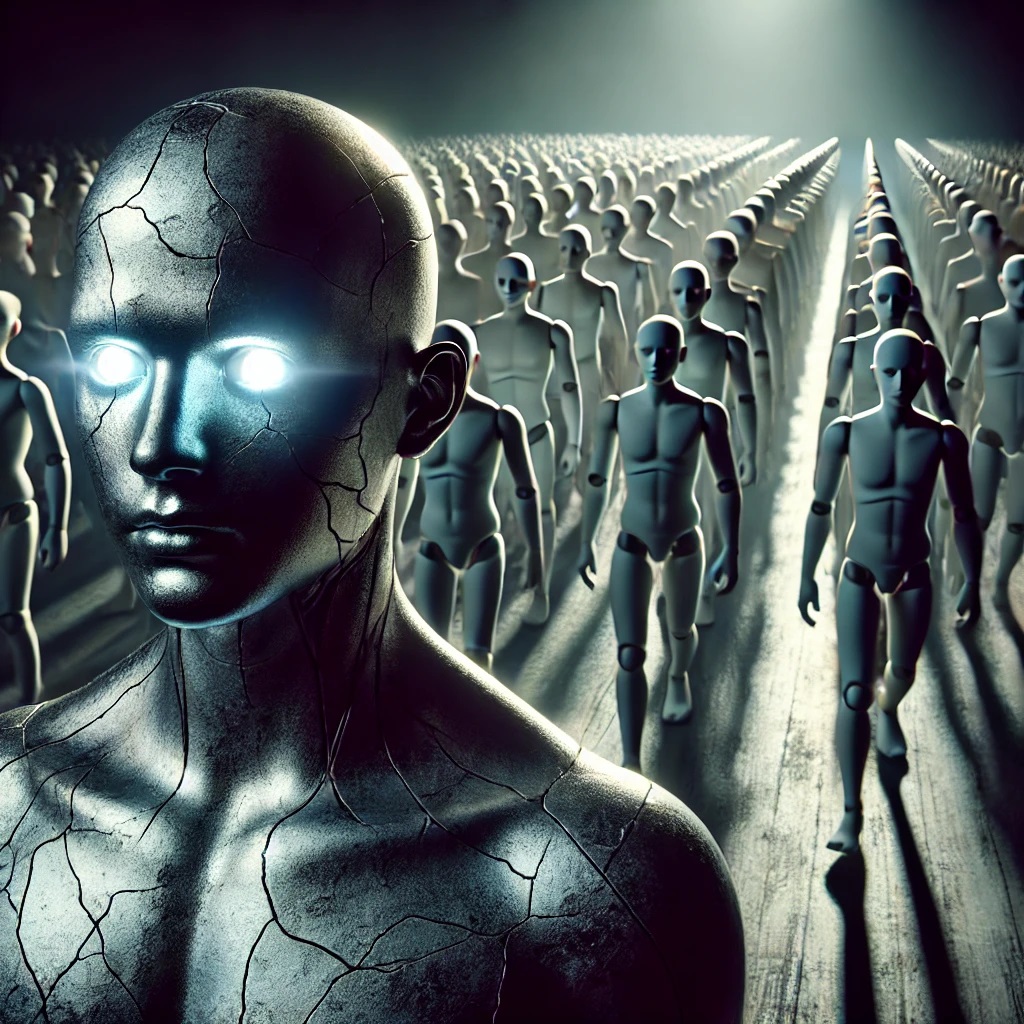
Within such environments the individual no longer inhabits a fixed moral identity. Instead, ethical reasoning becomes fluid, situational, and responsive to immediate conditions. Cooperation, deception, transparency, and concealment cease to be permanent virtues or permanent sins. They become instruments deployed according to necessity.
The environment decides which ethical posture survives.
The deeper implication is far more unsettling than the collapse of any single moral doctrine. It is the recognition that the stability required for permanent moral systems may itself be historically exceptional. Civilizations experience brief periods during which institutions maintain order long enough for static ethics to flourish. During those intervals moral permanence appears obvious.
But outside those intervals the world behaves differently.
Power shifts. Authority fragments. Systems mutate faster than doctrine can respond. The moral frameworks inherited from stable periods begin to feel strangely detached from reality because they were constructed for environments that no longer exist.
Under such conditions morality does not disappear.
It transforms.
Transitive ethics is the form that transformation takes. It is the ethical logic of unstable systems, the adaptive orientation that emerges when the illusion of permanent order collapses. It governs the behavior of individuals navigating worlds where survival depends not upon adherence to fixed doctrine but upon the capacity to move with the changing terrain of power, risk, and opportunity.
Civilizations will continue to describe their moral systems as universal because the alternative is uncomfortable to confront. Yet the pattern is clear to anyone willing to observe history without illusion.
Stable ethics belong to stable worlds.
Unstable worlds produce transitive minds.
And unstable worlds are far more common than civilizations prefer to admit.
If this essay was worthwhile, subscribe to receive future writings from Untranquil.
Essays on power, perception, autonomy, and the architecture of the modern psyche.

Leave a Reply